Hey guys, Vanessa here! Welcome back to The Vanessa Style. If you’ve been following me for a while, you know I practically live in my lululemon gear. Seriously, I’m always hunting for the best unboxings, reviews, and styling hacks for you all. Speaking of which, before we dive into today’s deep dive, if you want to score some of my absolute favorite pieces without paying full price, make sure to bookmark my ultimate lululemon sale guide. I update it religiously so you never miss a markdown!
Lately, there’s been a ton of chatter in the fitness community about yoga mats. Are the high-end ones really worth it? To get to the bottom of this, I looked into some recent industry data and a massive new review by WIRED. Grab your iced matcha, let’s get into the tea!
📌 The Big News: WIRED’s Test & lulu’s Challenge
So, the editors over at WIRED just spent an entire day brutally testing a bunch of yoga mats to put together their definitive buying guide. This piece actually dropped at a pretty wild time—lululemon’s stock is currently down about 63% from its peak, and they’ve been facing some serious heat regarding slipping North American sales and an aging product lineup. Honestly, right now, objective third-party reviews are influencing our buying decisions way more than standard brand marketing.
🔑 Key Takeaways
- Mats are a core lulu staple: Yoga mats make up over 35% of lululemon’s accessories revenue. It’s totally one of their most iconic signature products.
- We trust third-party reviews more: With the brand facing some skepticism, honest reviews from outlets like WIRED are holding a lot more weight for shoppers than flashy ad campaigns.
- The competition is fierce: Brands like Manduka, Liforme, and Gaiam are bringing their A-game, stepping up with better value, eco-friendly materials, and pro-level performance to stand out.
- Prices are all over the place: The market is super split right now, ranging from $20 for an entry-level mat to well over $150 for the ultra-premium ones. We literally have so many options!
🔍 The Industry Scoop
Get this: the global yoga mat market hit around $1.5 billion in 2025 (shoutout to Grand View Research for the stats), and it’s growing at about 6% every year. Thanks to the post-pandemic boom of both at-home workouts and a return to studio flows, mats have transitioned from “niche pro gear” to a total “must-have everyday fitness item.” According to the NPD Group’s 2025 sporting goods report, online sales for yoga mats jumped from 35% in 2019 to a massive 58% in 2025. E-commerce is the main battlefield now! lululemon’s mats (sitting pretty between $78-$128) are feeling the pressure from heavy hitters like Manduka ($80-$120), Liforme ($100-$150), and budget-friendly Gaiam ($20-$40).
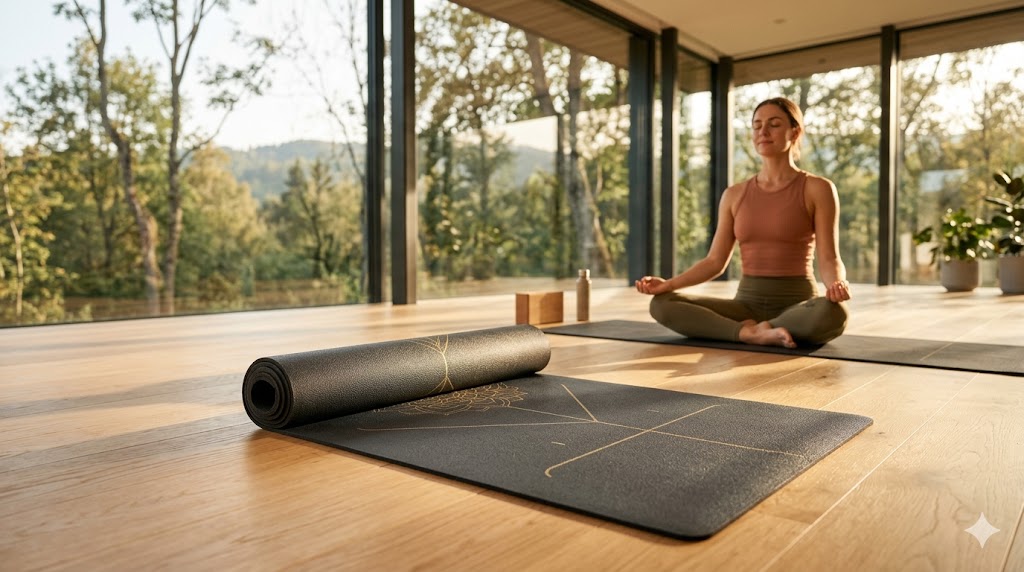
📊 What Are We Actually Buying?
- Our priorities have shifted: We are definitely caring less about the “brand flex” and way more about the price-to-performance ratio. A YouGov survey from 2025 showed what really drives our purchases: “Grip/Slip resistance” (72%), “Thickness/Comfort” (65%), and “Eco-friendly materials” (48%) completely beat out “Brand name” (38%).
- Eco-friendly is trending hard: Mats made from natural rubber, TPE (Thermoplastic Elastomers), and cork are blowing up. Statista notes that the market share for eco-mats shot up from just 15% in 2020 to 32% in 2025!
- Pro vs. Everyday markets: Professional mats (like Liforme’s alignment lines and Manduka’s lifetime guarantee) are targeting the hardcore yogis, while the mass market (think Gaiam or Amazon Basics) is winning on affordability.
- Smart mats are entering the chat: Startups are dropping smart mats with built-in sensors to track your posture and pressure in real-time. CB Insights reported over $50 million in funding for smart mats in 2025 alone. Crazy, right?
💼 The Business Side of Things
🎯 Quick Stats Drop
- $1.5 Billion: The size of the global yoga mat market in 2025 (via Grand View Research).
- 58%: The share of mats sold online now, compared to just 35% in 2019 (via NPD Group 2025).
- 32%: The market share for eco-friendly mats, up from 15% in 2020 (via Statista).
📈 Where Are We Heading?
Short-term (2026): The market is going to get even more specific. We’ll see clear lines between entry-level ($20-$40, budget babes), professional-grade ($80-$150, pure performance), and eco-grade ($50-$100, sustainable focus). If lulu wants to keep that premium crown, they absolutely have to innovate—whether that means dropping a smart mat or seriously upgrading their eco-materials.
Long-term (2027-2028): Get ready for the smart mat takeover! Built-in sensors and AI posture correction are going to totally redefine what a yoga mat even is. CB Insights is projecting that the smart mat market could smash past the $200 million mark by 2028.
🌐 Which Mat is For YOU?
The Target Shopper: Urban women aged 25-45, hitting the mat 2-4 times a week. You’re doing a mix of living room sessions (hello YouTube and Apple Fitness+) and local studio classes. You’re totally fine dropping $80-$150 on something high-quality.
How We Use Them: On hard floors or carpets at home (needs serious grip and cushion), dragging it to the studio (needs to be lightweight and easy to wipe down), and traveling (needs to be super packable).
My Quick Cheat Sheet: Pick based on your flow!
✨ Low-intensity (Hatha/Restorative): Go with the lululemon The Mat (that 6mm cushion and smooth Nulu™ feel is heaven).
✨ High-intensity (Vinyasa/Hot Yoga): Grab the Liforme (unbeatable grip when you’re sweating, plus those alignment lines are lifesavers).
✨ Best on a Budget: You can’t beat the Gaiam Premium (4mm, eco-friendly TPE, and only around $35).
❓ Your Yoga Mat FAQs Answered
Q1: Why is the lululemon mat so darn expensive?
A: At $78-$128, you’re definitely paying a premium for the iconic branding and their retail experience, plus some material R&D (like The Mat’s mix of natural rubber and a microfiber top). But, as WIRED pointed out, competitors like the Manduka PRO offer crazy good durability and grip for a similar price. So, is the logo worth it? That’s totally up to your personal vibe.
Q2: How often should I actually be replacing my mat?
A: It really depends on how much you sweat! Studios usually say if you practice 3+ times a week, swap it every 6-12 months. If you’re a 1-2 times a week kind of girl, it’ll last 1-2 years. Manduka does offer a lifetime warranty on their PRO series, whereas lululemon doesn’t have a strict warranty for mats. The rule of thumb? If you’re slipping, the surface is flaking, or it smells funky even after a deep clean—it’s time for an upgrade.
Q3: Are “eco-friendly” mats genuinely better for the planet?
A: Kind of! Natural rubber mats (like Liforme) use sap from sustainably farmed rubber trees and are biodegradable. TPE mats (like Gaiam) are recyclable. However, just because it says “PVC-free” doesn’t mean it has zero footprint—manufacturing still uses energy and water. According to a 2025 Greenpeace report, a truly “zero impact” mat doesn’t quite exist yet, but looking for recyclable packaging and carbon-offset certifications is a great step in the right direction!
What’s your go-to mat right now? Let me know in the comments below, and don’t forget to check my deals page if you’re ready to upgrade your flow!